

Bespoke Projection Surface Design: Elevate Your Home Cinema
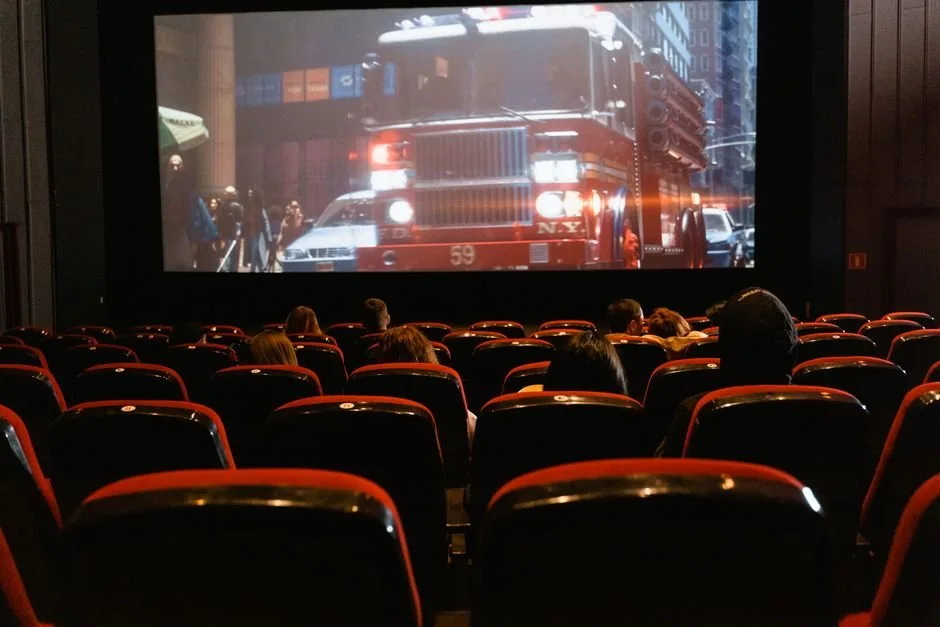
A high contrast projection screen is one of the most important — and most overlooked — decisions in a home cinema build. Most homeowners focus almost entirely on the projector and treat the screen as an afterthought. That’s a costly mistake: the screen is the image. Every lumen your projector produces lands on that surface first, and how the material reflects, absorbs, and diffuses that light determines what your eyes actually see.
Why a High Contrast Screen Beats Standard Matte White
Projectors can’t project true black — the blackest part of your image is simply the native color of the screen when no light is hitting it. On a standard matte white screen, any ambient light in the room, or light reflecting off pale walls and ceilings, raises that baseline. Dark scenes end up looking grey and muddy instead of rich and cinematic.
A high contrast screen uses a grey or specially coated surface to absorb stray light and reflect only the projector’s targeted beam. Because grey absorbs light evenly across the spectrum, it lowers black levels without shifting color saturation or neutrality. The result: dark scenes regain their tension, and shadow detail that would otherwise disappear becomes visible again.
Screen Gain and Viewing Angle
Screen gain measures a material’s reflectivity against a standard matte white reference (gain of 1.0), and it comes with a real tradeoff:
- Low gain (0.7–0.9) — common in high contrast grey screens — diffuses light widely for excellent viewing angles, but needs a brighter projector to keep highlights punchy.
- High gain (1.1–1.5) focuses reflected light back toward the center of the room. It brightens the image but narrows the viewing angle and can introduce “hot-spotting,” where the center looks brighter than the edges.
In a wide media room with multiple rows of seating, diffusion uniformity matters — a screen with a narrow half-gain angle will leave off-center viewers with a dimmer picture.
Ambient Light Rejecting (ALR) Screens
Where a standard high contrast screen relies on a simple grey tint, Ambient Light Rejecting (and Ceiling Light Rejecting) screens use a microscopic lenticular structure etched into the surface. That structure is built to reflect light coming from a specific angle — the projector — straight to the viewer, while absorbing or redirecting light from other angles, like windows or overhead fixtures. ALR materials are especially useful in multi-purpose rooms with ultra-short throw (UST) projectors, where a screen not rated for UST use will simply reflect the projector’s light straight up into the ceiling.
Features Worth Specifying
A few structural details separate a screen that performs for years from one that doesn’t:
- Tab-tensioning — essential for electric roll-up or drop-down screens, a tensioning cable system keeps the material taut and prevents edge-curling and waves over time.
- Acoustic transparency — if you want front speakers hidden directly behind the screen, a perforated material lets sound pass through without sacrificing contrast.
- Form factor — a fixed-frame screen suits a dedicated, always-dark theater, while multi-purpose living spaces often call for a motorized screen that disappears when not in use, including floor-rising options for rooms where wall or ceiling mounting isn’t practical.
Matching the Screen to the Room and Projector
The screen, the projector, and the room have to be treated as one system. A lower-gain, high contrast grey screen needs a projector with strong native lumen output to keep whites bright. Ultra-short throw projectors require a screen specifically rated for UST use, while standard and long-throw projectors pair well with standard high contrast or ALR materials. For sizing, industry guidance from THX recommends a viewing distance of roughly 0.84 times the screen’s diagonal for an immersive field of view — so a seating row about 10 feet from the screen typically points toward a 100 to 110-inch diagonal.
Getting It Right the First Time
Choosing the wrong surface can wash out your image and flatten shadow detail even on an excellent projector. Matching screen material, gain, and form factor to your room’s ambient light, seating layout, and projector is a genuinely technical decision — one worth working through with an integrator before you commit to hardware. If you’re planning a home cinema, it’s worth having that conversation early, so the screen is designed into the room rather than bolted on as an afterthought.